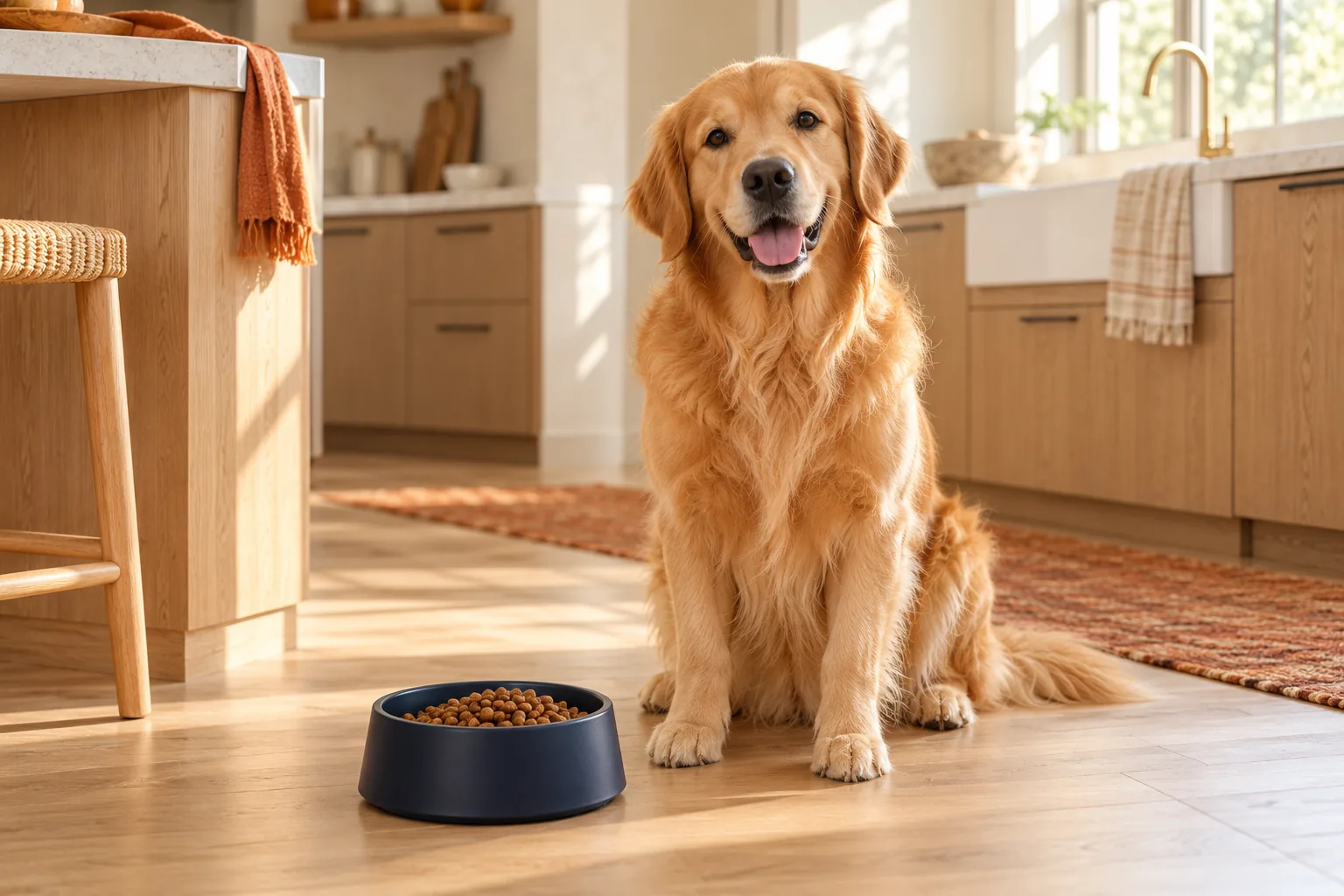
There is no single amount that suits every dog. A Chihuahua and a Great Dane need very different-sized meals, and two dogs of the same breed can differ too. The practical approach recommended by UK vet charities and the pet food industry is to start from the feeding guide on the packet, weigh the food out, then adjust to your dog’s body condition. Here is how.
Start with the feeding guide on the packet
The best starting point is the feeding guide printed on the food’s packaging, or on the manufacturer’s website. UK Pet Food advises owners to follow these guidelines as a starting point and to weigh the food out, because the margin for error with measuring cups and guesstimates is too great.
The guide usually shows a total daily amount for your dog’s weight, which you then split across the day’s meals. Because that figure is specific to one food, it will change if you switch products: a higher-calorie food needs a smaller portion than a lower-calorie one. If you are unsure where to find the feeding guidance or calorie information, our guide to reading a dog food label walks through it.
Weigh the food rather than guessing
Manufacturers’ feeding guides and calorie figures are based on the food’s weight in grams, so measuring by volume with a cup, scoop or handful is easy to get wrong. UK Pet Food recommends using accurate kitchen scales to weigh each portion to the exact amount shown on the guide. It is the simplest way to keep portions consistent from day to day.
Check your dog’s body condition, not just the scales
Scale weight alone does not tell you whether a dog is the right shape. A body condition score uses how a dog looks and feels to place them on a 9-point scale, where the middle band (4 to 5) is the healthy zone. PDSA describes a check you can do at home:
- Run your hands along the sides. You should feel the ribs with a light touch, and the skin should move freely over them.
- Run your hands along the back. You should be able to feel the spine and hip bones without them being visible.
- Feel the base of the tail. There should not be a build-up of fat.
- Look at the tummy from the side and from above. It should tuck in, and you should be able to see a waist.
Checking body condition regularly, alongside weighing, gives a far clearer picture of whether the current amount is right than either measure alone.
What changes how much your dog needs
A dog’s needs vary through life and between individuals. The main things that affect how much to feed are:
- The food they are currently on, because different foods have different calorie densities
- Their weight and body condition
- Their age and life stage
- Their activity level
- Breed and size
- Any medical conditions
Because nutritional needs differ at each stage, UK Pet Food recommends a life-stage diet formulated for your dog’s current stage, whether puppy, adult or senior. For how the two main food types differ in calories and cost per meal, see our wet vs dry dog food comparison.
How many meals a day?
There is no fixed rule for how often to feed. Some owners feed once a day, others two, three or four times. The important part is the right total amount of the right food for your dog’s age and lifestyle. Dogs are natural scavengers and will often eat whenever food is available, which makes overfeeding easy, so measure the day’s total first and then divide it into meals.
Treats count towards the daily total
Treats and snacks should not make up more than 10% of your dog’s daily calories, leaving at least 90% to come from a complete food. If you give treats during the day, reduce the main meal to make room for those extra calories. PDSA makes the same point: if you add treats, reduce the food in the main meals to make up for them.
When to adjust the amount
Feeding guides are a starting point, not a fixed instruction. The aim is to feed to your dog’s ideal body condition, then adjust based on any weight they gain or lose. If your dog is creeping above the healthy range, reduce the amount slightly and re-check in a couple of weeks; if they are too lean, increase it. If you are changing foods at the same time, do it gradually. Our guide to switching a dog’s food gradually explains how.
If your dog is very overweight, or you are worried about their weight either way, ask your vet or vet nurse for help. Many vet practices run weight clinics, and obese dogs may need a specific diet and closer monitoring than a simple portion change provides.
Puppies, adults and seniors
Puppies move onto adult food once they reach skeletal maturity, which depends on their expected adult size. Small breeds may be considered adult from around eight months, while larger breeds such as Great Danes or St Bernards may still be growing at two years old. UK Pet Food strongly recommends a vet assess your dog before you make that switch, and that you introduce the adult food gradually over about a week.
Whatever food you choose, keep fresh, clean drinking water available. UK Pet Food’s 1+1 rule suggests one water bowl per pet in the house, plus one extra.
Should I weigh my dog’s food?
Yes. Feeding guides are based on the food’s weight in grams, so weighing each portion on kitchen scales is far more accurate than measuring by cup or scoop.
How many times a day should I feed my dog?
There is no fixed rule. Once, twice or several times a day can all work, as long as the total daily amount is correct for your dog’s age, size and lifestyle.
How do I know if I am feeding too much?
Watch your dog’s body condition. If you can no longer feel the ribs with a light touch, there is fat at the base of the tail, or the waist is disappearing, the portion may be too large. Reduce it slightly and check again in a couple of weeks.
When should I ask a vet about my dog’s weight?
If your dog is very overweight or underweight, or you are unsure how much to feed, ask your vet or vet nurse. They can weigh your dog accurately, assess body condition and, where needed, suggest a diet plan.
Sources
- PDSA — Your dog’s Body Condition Score
- PDSA — Vet Q&A: How much should I feed my dog or cat?
- UK Pet Food — Feeding guides for dogs and puppies
- UK Pet Food — Calculating how much to feed
- WSAVA — Global Nutrition Toolkit (body condition score charts)